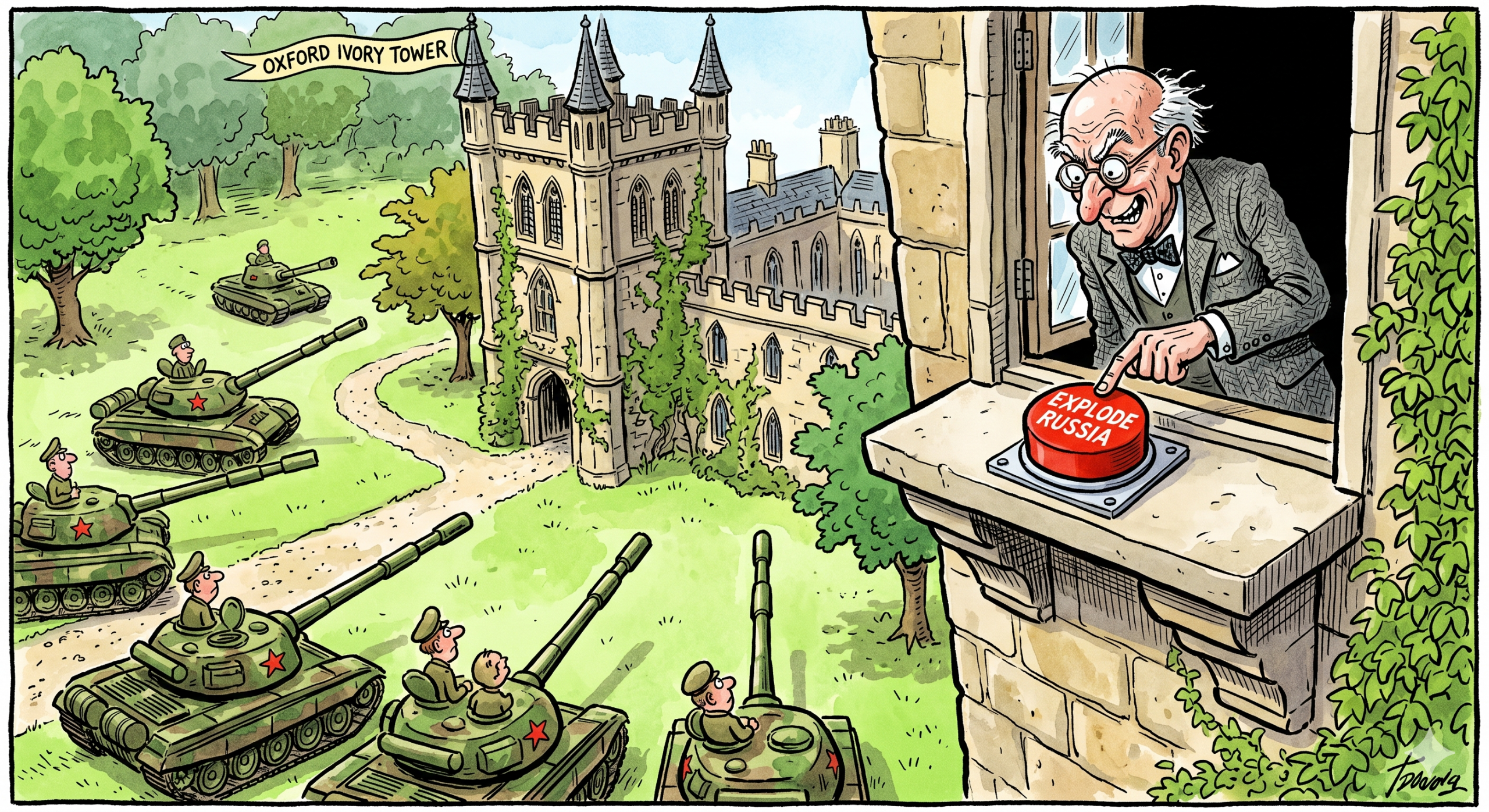
It is very, very hard to believe that the author of this article is a Professor of history (or European studies) at Oxford University. I recognise that Oxford University is preeminently a symbol and agent of the British establishment – with all the very unattractive baggage that that brings with it, (links to slavery, bourgeeois pseudo-philosophy, swan eating, neworking for the city, a monopoloy on ‘justice’, and so on), but, even so, it still has a scholarly reputation. I read a lot of history and if I see that the author is from Oxford or Cambridge I feel assured that I will be getting scholarship. I know not to expect a radical view, almost certainly not a view of history which is aware of Marxism, but, nonetheless, scholarly. So, I find it hard to believe that the author of this nonsense in the Guardian is an Oxford don, but apparently he is.
The article is a series of bullet points on how to “defeat Vladimir Putin”. As with all this war-mongering stuff, the entire Russian population is elided into one token enemy, “Vladimir Putin”. The demonisation of one man helps to shield us from the truth that what is being proposed is a war on a people. I wouldn’t bother to critique this article – it is such abject nonsense, free of both empircal evidence and argument, (the two mainstays of scholarship – which is why I am so surpised that the author is linked to Oxford), that, normally, I wouldn’t think it worth critiquing. But; there is a reason. The Guardian is putting this out. They open a comments section. But, they then block critical comments. Only pro-war comments are permitted, and a few anti-war ones, but only if they are not very strong arguments. This is manufacturing consent. It is an intelligence operation, (even if MI6 is not directly involved).
This is what the Guardian won’t allow their readers to see:
Ukraine could have been in the EU, (subject to them meeting the conditions and all member states agreeing), and ‘prosperous and free’, if a) they had implemented Minsk and b) NATO had not forced itself on Ukraine. (In 2014 joining NATO was a minority concern in Ukraine with support at less than 20% in the Eastern provinces according to Gallup). Yes, without Crimea, where there is a majority Russian population and multiple Western polls have confirmed the 80%. Putin has repeatedly said he would not block Ukraine joining the EU. The actual blocker is Ukraine does not meet the conditions; corruption, democracy, and respect for minority rights being some of the problems, as well as the Hungarian problem, (the new leadership in Hungary is also unethusiastic). The blocker was and is the EU and the mono Ukranian nationalists in Ukraine. Finally, evidence of Putin’s supposed dream of rebuilding the Russian Empire – none. Even the notorius essay makes it clear he saw Ukraine as an independent country. Evidence that the problem is NATO? Look, for example at Ambassador Burn’s telegram about Russian red lines.
The reason they won’t publish this comment, and this I know because of multiple such cases, is because it is a strong argument supported by checkable facts. I monitor which of my comments are blocked on the Guardian and it is precisely the ones that meet these criteria. They sometimes allow a few throwaway remarks which question the war narrative, but the strongly argued ones, with facts, are always blocked. Go figure.
The author’s article presents his ideas “how to defeat Vladimir Putin”. Extracts and comments:
No dictator lasts for ever. One day Vladimir Putin will be gone. Recent reports suggest growing weakness in the Russian economy, discontent in society and a waning of confidence inside his regime – but it would be foolish to conclude the end is near. Only death or Russia can depose Putin, and nobody knows when or how that will happen. What democracies in Europe and beyond can do is hone a strategy to defeat his external ambitions. Here’s a non-exhaustive list of eight elements of such a strategy.
For someone who is an Oxford Professor, and who has apparently won a lot of awards, we are off to a weak start. There seems to be an implicit assumption here that the problem is “Vladimir Putin” and his demise would end the problem. This is simply uninformed. No one can know what kind of political setup will emerge in Russia after Putin goes. We do know that Russia has a strong constitution and processes for choosing a leader. Putin is still popular in Russia. The Russian political class is quite collegiate. All the main parties are, with some reservations, behind the “special operation”. It is likely that after Putin the country will continue in the same direction it is at present, at least for a while. Not certain, but likely, based on the evidence. So, all these dreams that the problem is Putin and his fall/death would solve the problem show that people are not thinking. This a very superficial view.
Putin aims to subjugate Ukraine, restore as much as possible of the Russian empire, destroy the credibility of Nato, undermine the European Union and re-establish a Russian sphere of influence over eastern Europe. To prevent him achieving these goals is to defeat him.
Oh God. Here we go. Just because you repeat something 100 times, Mr Garton Ash, doesn’t make it true. You need evidence. And, as we all know, there is, basically, no evidence that Putin is trying to restore the Russian Empire, (or the USSR). There just isn’t. Even in his well-publicised essay in which he tries to cast doubt on the validity of Ukrainian nationhood, Putin still talks about a partnership with Ukraine. [1] For example; “We are natural complementary economic partners. Such a close relationship can strengthen competitive advantages, increasing the potential of both countries.”. Then there is the quoted out of context statement Putin made about the fall of the USSR being the greatest geopolitical catastrophe of the 20th century. In fact Putin immediately commented that it would in reality be impossible to re-create the Soviet Union. [2] And these are about the only two pieces of ‘evidence’ put forwards to support the ‘imperial theory’. On the other hand, the view that Russia’s special operation was due to the reasons stated; the push to put NATO into Ukraine and the plight of the ‘pro-Russia’ population in Donbas, is easy to support by consistent historical evidence. For example, my reference in my censored comment to Ambassador Burns, refers to a telegram then US Ambassador Burns sent from Moscow to Washington in 2008, in which he said:
Ukrainian entry into NATO is the brightest of all red lines for the Russian elite, not just Putin. In more than two and a half years of conversations with key Russian players, from knuckle-draggers in the dark recesses of the Kremlin to Putin’s sharpest liberal critics, I have yet to find anyone who views Ukraine in NATO as anything other than a direct challenge to Russian interests [3]
Those, like Garton Ash, who propose the ‘imperial narrative’ have to assert that the entire Russian politial elite for 20 years has been working together to pull the wool over our eyes; pretending to be worried about NATO expansion, while secretly planning a move to ‘recreate the Russian Empire’! They also have to explain why, if this is the case, Putin did not move on Ukraine much sooner, long before it was flooded with Western arms and CIA spy bases. The fact is, there is no evidence for the ‘imperial’ narrative, and a huge stack of evidence that the reasons for the war are, pretty much, the ones Russia has stated.
(It is important to remember that joining NATO was not a popular demand in Ukraine. Support only just went over 50% long after Maidan, and after hostilities started heating up. In the East and Crimea, it is safe to assume it remained very low).
But the highest risk of a Russian attack on Nato and EU territory probably comes in the earliest years of that transition [a drawdown of US forces], especially in 2027-28.
This is insane. As Putin said, “only a madman in his delerium would attack NATO”. The idea is insane on multiple levels. Why would Russia attack the West? What for? What story can be told in which it would make sense for Russia to attack the West and provoke a war with NATO? They want to steal our gas and oil? It is crazy. This supposes, then, that Russia is simply a wild beast prone to irrational aggression. It is possible that Garton Ash and his circle genuinely see Russia in these terms. But, this view is no more valid then the delusions of a psychotic. All serious observers note that Putin is very cautious and only moves when he is confident of a reasonable chance of success. As Putin knows, Russia would not do well against NATO. One can postulate an “attack” in Estonia or Lithuania – as Garton Ash posits, but only if there was some huge provocation against the Russia speaking, and ethnic Russian, population there. All the more reason, one would have thought, to integrate and respect the Russian minority population in Lithuania. [4] One imagines though they would use the same playbook as they have in Ukraine; conivance in nationalist suppression of minority (Russian) rights [5] and when Russia, finally intervenes, following years of failed dialogue, inventing a story about Russia “recreating the Russian Empire”.
Yes, it’s worth keeping channels of communication open to the Kremlin, including back channels. But the only language Putin really understands is military and economic force wielded with political will.
Another vulgar and uniformed sterotype. In reality; it is Europe and the West who “don’t listen”. For example; the push to get Ukraine into NATO went ahead despite clear and frequent Russian warnings, (and in contradiction to at least verbal assurances given to Gorbachev that NATO would not expand after German re-unification). [6] And, according to UK scholar Richard Sakwa, the EU couldn’t even bring themselves to discuss with Russia legitimate concerns Russia had about the Ukraine EU Association Agreement. [7] And, have you heard Kaja Kallas or von der Leyen recently? It is the West, and the EU who are not listening, not Russia.
More important is talking to three other Russian constituencies: business, professional and even bureaucratic elites still in the country; wider Russian society; and the “Other Russia”, now living largely outside Russia and desiring the defeat of Putin more fervently than anyone. While the specific messages would be different, there would be a common theme: “another relationship with Russia is possible, if …” This will make little difference in the short term but can bear fruit when the moment of change comes.
Firstly; is this a proposal for honest dialogue or Integrity Initiative style targetted and curated information operations? It looks like the latter. The so-called ‘Other Russia’ refers to a minority of dissidents, in some cases, (if not all), funded by Western intelligence. Irrelevant within Russia. As for the bureaucratic elites and professional classes, Garton Ash is deluding himself if he thinks they can be subverted; support for the direction of the Kremlin is widespread, (anecdotally, it is true, but having been in Russia this is my clear impression). The business class, yes, I would assume would welcome an end to the war, for obvious reasons. But, overall, what is being proposed, is simply an absolutely standard regime change recipie. Talk to dissident and special interest groups and try to subvert them into joining the Western system and playing by our rules, and on our terms. that is what is being proposed. Surely a modern historian might have noticed that there is a long list of failed regime change operations. Afghanistan, Libya, Syria, (now ruled by a former ‘Islamic terrorist’), (Iran, apparently, as we write). The Iraq war may have got rid of a previously supported by the West but now unwelcome dictator, (as was also the case in Libya and if we count the Mujahideen also the case in Afghanistan), but the casualty count was truly immense. Regime change operations, based on cultivating self-interested special groups, have, at best, a very chequered history. And, Russia is a much more organised modern state than any other the liberal democracies of the West have targetted. I simply don’t understand the democratic regime change theorists. What is the problem with allowing Russia to do its thing, and be Russia? Why do they have to be recreated in our image? It can’t even be entirely due to economic factors; before the war Russia was open to trading with the West and, certain restrictions on strategically significant areas aside, allowed FDI. It really does seem, at least, in part, we just can’t tolerate difference.
I spent more years of my life than I care to remember studying western policies towards the Soviet Union. One conclusion was clear: the most important thing we did to win the cold war was not anything in our foreign policy but simply making our own societies secure, strong, prosperous and attractive – and then “standing there”. So also now. Significant political change in Russia might come tomorrow, or not for another 10 years. The most difficult challenge for a diverse bunch of liberal democracies is also the most important: strategic patience. Achieve it, and time will be on our side.
And, finally, something just beginning to resemble sense. Yes; if Western liberal democracies, (no matter that they are generally being taken over by an extreme idological pre-rational cult at the moment, but that is another story), are so fantastic, then, why not do exactly that and just that. Set an example, and Russia might follow. Again, though, this is barely thought through, and extremely superficial. What is much more likely in this scenario is that what will happen is that Russia will adopt some aspects of liberal democracies, and adapt them to their own path of development. This, simply put, is what seems to happen when cultures meet in decisive ways. For example; you can buy a MacDonalds in Saudia Arabia, but they still wear robes and keep women out of public life. Anecdotally; I have heard several different lines from intelligent Russian university students. Some are patriotic and are on the same page as the Kremlin, some are politically agnostic, a very few are real Westernisers. And some talk about a Russian social democracy, but, these ones, who may well become more significant in the future in Russia, are often critical of the power of corporations in Western society. They are not proposing the wholescale surrender which Garton Ash is dreaming of. Those who are are in a tiny minority, even amongst the young end educated.
I find it really hard to believe that Garton Ash is an Oxford Professor. The intellectual level here is so superficial, it is incredible. Of course, this could really be part of the Integrity Initiative, (a British intelligence operation to spead anti-Russian propaganda in the media); that would explain it. But, I don’t know. More likely, he is just another Western academic who has heard and reproduced certain narrative lines so often he has come to believe them as self-evidently true, as true and solid as the walls that surround him in his study in Oxford.
Notes
- http://en.kremlin.ru/events/president/news/66181
- “He [Putin] reiterated that view in April 2005 when he characterized the break-up of the Soviet Union as ‘the greatest geopolitical catastrophe of the twentieth century’ but promptly added that it was impossible to fantasize about resurrecting the old Soviet state”. Freeze, Gregory L.. Russia: A History (p. 495). OUP Oxford. Kindle Edition
- https://cirsd.org/horizon-article/the-causes-and-consequences-of-the-ukraine-war/
- https://www.coe.int/hr/web/commissioner/country-work/lithuania/-/asset_publisher/hSIh0Ipyme9V/content/the-commissioner-discussed-minorities-rights-and-discrimination-issues-during-his-visit-to-lithuania
- e.g. language rights. https://www.france24.com/en/live-news/20210401-new-law-stokes-ukraine-language-tensions But, in reality, the violent outster of elected President Yanokovich was a suppression of these people’s rights since Yanokovich was more popular in the East. “Viktor Yanukovych’s closest ties and support base have always been with mainly-Russian speaking eastern and southern Ukraine.” https://www.bbc.com/news/world-europe-25182830
- “Robert Gates, CIA director at the time, later argued that ‘Gorbachev and others were led to believe that [expansion] would not happen” Sakwa, Richard. The Lost Peace: How the West Failed to Prevent a Second Cold War (p. 100). Yale University Press. Kindle Edition.
- Barroso being quoted by news agencies as late as 29 November 2013 as saying: ‘Russia’s inclusion in the talks on setting up an Association Agreement between the EU and Ukraine is wholly unacceptable.’ Sakwa, Richard. Frontline Ukraine: Crisis in the Borderlands (p. 76). Bloomsbury Publishing. Kindle Edition.