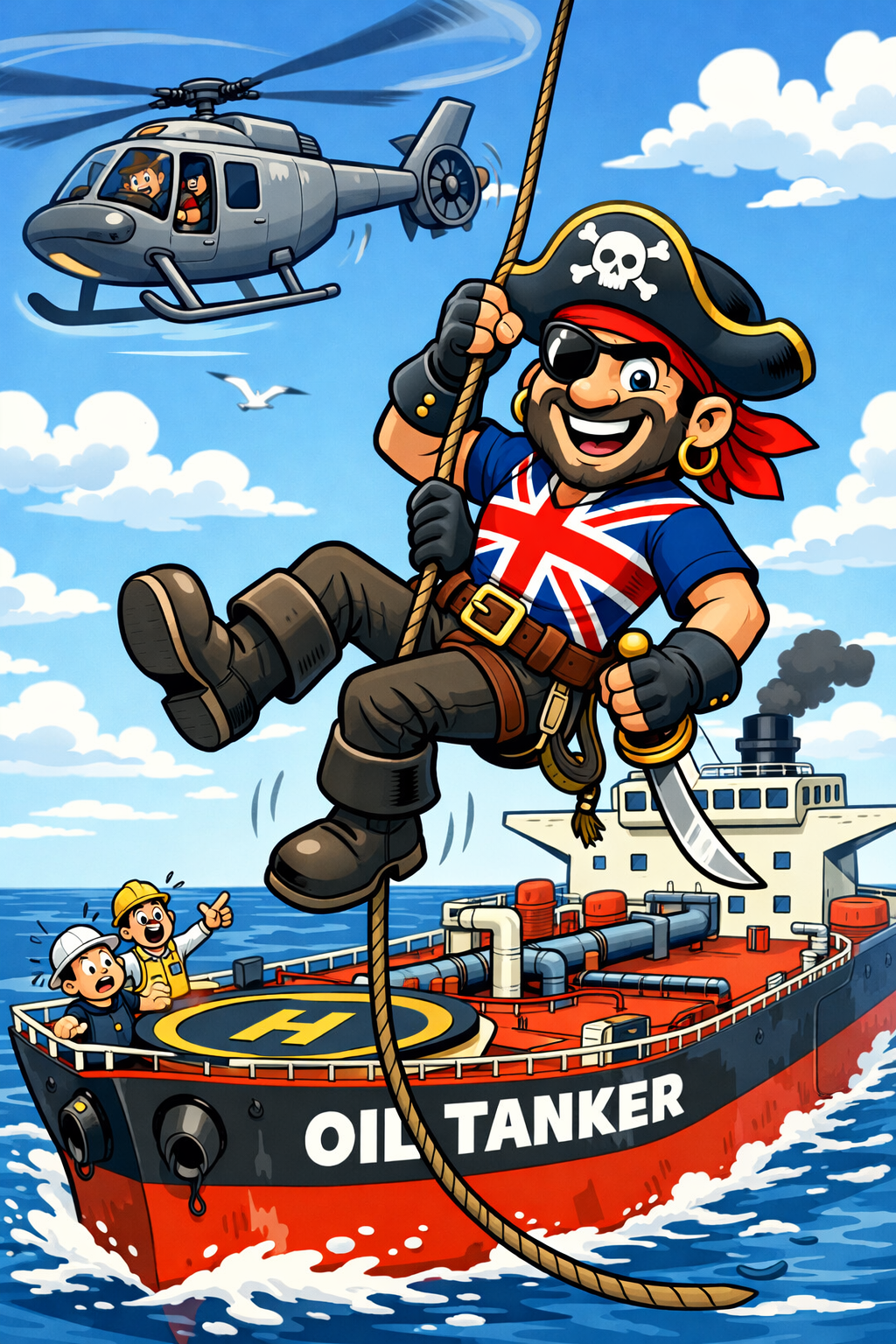
The UK has captured and taken full control of a Russian tanker in the channel. According to the BBC, citing a shipping website, the tanker flies the flag of Cameroon. I hope it doeesn’t because if it does that would make this action doubly illegal. They have taken the captured ship and anchored it off our coast.
This is wholly illegal.
Firstly; the United Nations Convention on the Law of the Sea (UNCLOS), allows countries to “visit’ unflagged shps. Clause 110 of UNCLOS permits a country to board and inspect suspected unflagged ships. It doees not permit them to capture them and tow them away:
1. Except where acts of interference derive from powers conferred by treaty, a warship which encounters on the high seas a foreign ship, other than a ship entitled to complete immunity in accordance with articles 95 and 96, is not justified in boarding it unless there is reasonable ground for suspecting that:
(a) the ship is engaged in piracy;
(b) the ship is engaged in the slave trade;
(c) the ship is engaged in unauthorized broadcasting and the flag State of the warship has jurisdiction under article 109;
(d) the ship is without nationality; or
(e) though flying a foreign flag or refusing to show its flag, the ship is, in reality, of the same nationality as the warship.
2. In the cases provided for in paragraph 1, the warship may proceed to verify the ship’s right to fly its flag. To this end, it may send a boat under the command of an officer to the suspected ship. If suspicion remains after the documents have been checked, it may proceed to a further examination on board the ship, which must be carried out with all possible consideration. [1]
If the tanker in question turns out to be legally flagged, then after a brief check of its paperwork UK authorities should have left it, (and paid compensation). There is simply no provision in UNCLOS for seizing a ship.
Secondily; even if the ship is unflagged, there is still no right to capture it and take control of it in UNCLOS. Those who want to claim such a legal right have to refer to “customary international law” – a highly disputed field.
My guess is the UK government’s attorney for hire – the one who gave them an opinion claiming such actions would be legal, is relying on claims that national legislaaton can be applied to ships in UK territorial waters.
The tanker may have been in British territorial waters – but, under UNCLOS, it has a right of free passage. This can be forfeited if the ship engages in war like activities, such as weapons practice or surveillance – or pollution. [2] The exact text regarding pollution: “any act of wilful and serious pollution contrary to this Convention;”. As far as I can see no one is claiming anything of that order. Another provision (21) gives the territorial state the right to adopt laws relating to environmental protection – but even if that is said to apply, due to the ship posing a risk by not using a Western insurance company – again, no provision to seize it, or even board it. I would guess that the UK government’s legal opinion rests on Article 19: “Passage is innocent so long as it is not prejudicial to the peace, good order or security of the coastal State. Such passage shall take place in conformity with this Convention and with other rules of international law.”. But – again, no right to seize is mentioned. But they would probably argue that if a ship loses its right to free passage due to violation of Article 19 it loses all its rights and can therefore be seized. This would be an entirely fractious legal argument.
Update: according to this BBC report, the vessel was in international waters when it was seized by Britain’s “brave” commandos. (There is even footage of the marines – faces not shown – moving through this civilian ship with their rifles pointing into every doorway), There is no conceivable legal justification for the UK to seize and capture a flagged ship of another country in international waters. None. It is totally outside international law as set out in UNCLOS, or the norms of how states behave. Attacks on another country’s merchant vessels are close to an act of war.
It would be interesting to see the UK government’s legal opinion. They always manage to get a system lawyer to produce one that puts them in the right. It is very important for the British establishment to feel that they are in the right. When they attacked Libya in 2011, helped local militias butcher our former arms client Mumar Gaddafi, overthrew the government and plunged the country into deep chaos, they claimed that UN Resolution 1973 which permitted military operations to protect civilians actually permitted regime change because that was the best way to protect civilians – a claim which has been shown to be false by subsequent events, and a nice example of legal provision inflation, or, more simply put, sophistry. When the UK illegally attacked Iraq in 2003 the Attorney General produced advice. Initially he said that the case was highly contestable. This advice was kept secret. Later, he claimed it was legal under the previous UN Resolution which placed certain restrictions on Iraq if taken together with a previous Resolution which had permitted military force – again, a big stretch of a legal argument.
I will try to see if the government has published the legal opinion they are relying on in this case. I am sure, either way, that it will be a case of another huge self-justifying stretch.
International law is not clear-cut. Relying on sophistry to attack Libya or Iraq is one matter. They can be militarily vanquished, so it doesn’t really matter if the legal opinion is a fig-leaf or if it has substance. The victors can write the laws. But – with Russia victory in a war is not assured, and we would be advised, obviously I would have thought, not to take actions which harm Russian interests on flimsy and contestable legal pretexts.
The UK is not under attack. If Russia were to retaliate Article 5 would not apply.
This deed is extraordinary. Why take an action which is so obviously high-stakes, when there is very little benefit – in terms of your stated aims? The answer is, unfortunately, that the political and military establishments in the UK are intoxicated by the peformative nature of the action. Basically, they want to poke Russia in the eye, purely for the sake of poking Russia in the eye. And they want to be seen to be poking Russia in the eye. And, of course, it is a useful distraction from the disastrous state of affairs at home; a huge debt, slow growth, rising energy costs, and anti-immmigration riots. And, in their delusion, they think this makes Britian look like a player on the world stage. They simply don’t realise that they look like fools playing a high-stakes game they are not equipped for.
I should add; now it is clear, apparently, that the ship was seized in international waters I am guessing that there is some kind of idea that this will put off shipping companies from working with Russian oil. I doubt that will have that significant effect; Russia is aquiring their own fleet. And, I would imagine if some shipping companies are put off, others will step up – less risk averse maybe, thus increasing the chances of some kind of environmental catastrophe. Meanwhile the UK continues to buy Russian refined products.
And next they will be complaining about Russian sabotage operations.
I would guess that some kind of sabotage operation will be precisely the response. And, who could blame the Russians?
One final thought. If this carries on what happens when they meet some Russian marines waiting for them in the control room?
Notes